Cuenca for Black Expats: My Experience
A first-year report. One Black man, one specific life, one city.
People ask me all the time what it's like being Black in Cuenca, and I never quite know how to answer quickly because the honest answer starts long before Ecuador. It probably starts with my parents.
My mother and father were both raised in Louisville, Kentucky during segregation and Jim Crow. By the time I came along, my father was in the Air Force and our family had already moved through several states. I'm the youngest of five kids, fourteen years behind the oldest, and each of us was born somewhere different because that's what military life looked like. I was born in Grand Forks, North Dakota, but almost all of my actual memories come from Gwinn, Michigan in the Upper Peninsula. Tiny town. Long winters. Mostly white. Almost no Black people besides a few military families connected to the base.
My parents believed they were giving us a better life by raising us there, and compared to what some of our relatives were dealing with in Louisville or Minneapolis at the time, they probably were. But growing up Black in a place where almost nobody looks like you shapes a person in specific ways. You learn early how visible you are. You learn how to make yourself non-threatening before you fully understand what threat they're reacting to.
I spent a lot of my younger life deep in what I now think of as go along, get along mode. Work twice as hard and be thankful for half as much. Be respectful. Stay calm. A lot of Black folks know that script.
Growing up where I did also made me difficult for people to categorize cleanly. I was the Black kid in the Upper Peninsula listening to hip-hop, punk, alternative rock, experimental and fusion jazz. I played basketball and drums. I watched The McLaughlin Group as a teenager because I was obsessed with politics and history. White people often read me as one of the good ones, right up until the moment I pushed back on racism even indirectly. Some Black people initially read me as too white before they got to know me. It was the black paradox. Too Black for the white kids, too white for the Black kids. You move through the world like that long enough and you get very aware of performance. Everybody's reading you through whatever framework makes them comfortable.
So when people ask what it's like being Black in Cuenca, that's the person who's answering. Not a universal Black experience. Just my own.
What my actual life here looks like
Before I get into what I've observed about race in Cuenca, I want to say something about the life I've built here in a year, because the rest of this piece won't make sense without it.
When you first move to a new country, you go where the language is familiar. That's true even when those spaces come with their own complications. For most North American expats here, that means English-speaking venues, English-language meetups, the places other Americans have made into informal community centers. I went to those places too, especially in the first months. They were easier when my Spanish was barely functional. They offered something useful even when they offered other things alongside it. I'm planning to spend less time in those spaces as my Spanish gets better, because the local spaces are where I actually want to be. But the early reliance on expat venues is real and I don't think Black expats should beat themselves up about it.
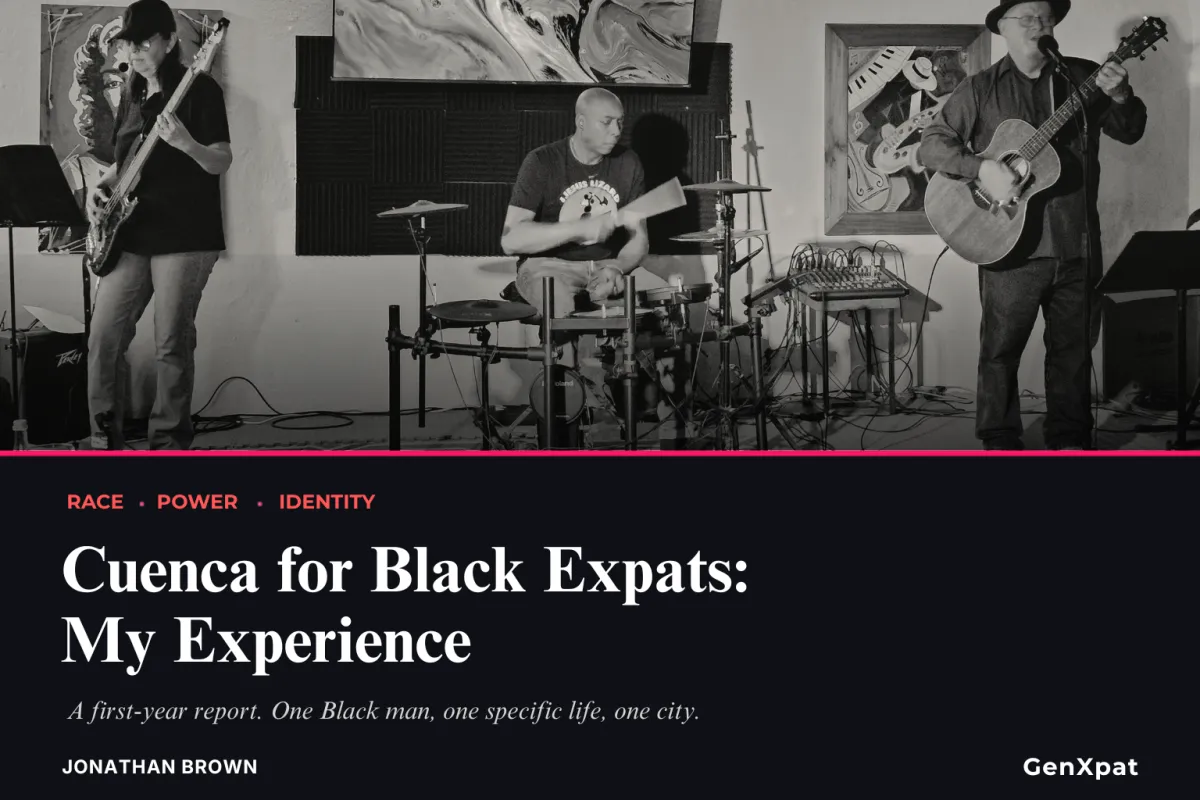
Outside of those places, my life here is fuller than I expected it to be a year in. I play in bands and gig around town. I'm a regular at Cuenca's professional basketball games with courtside season tickets, and I've become friends with several players and with the team's marketing director. There are social things during the season that have nothing to do with being Black or being American, just being a fan who shows up.
For my first birthday in Cuenca, more than twenty-five people came out to celebrate. The crowd was genuinely diverse. Ecuadorian friends, expat friends, Black, white, Latin American, mixed couples, single people, families. That night wasn't proof that everything is fine here. Plenty of the same people in that room could turn up in some version of the moments I'm about to describe. But it was proof that I'm not isolated. That something real is being built. That's the life this piece is being written from.
What I noticed first
One of the first things I noticed after arriving in Cuenca was that I wasn't getting the same kind of reaction from strangers that I was used to in the Midwest. At six feet tall, I'm taller than most people around me, so I'm still visible here. But the feeling is different.
In the United States, especially in the Midwest, visibility often came with a layer of suspicion or tension underneath it. Here, most of the attention feels more curious than fearful. Younger people, especially Gen Z and Alpha kids, sometimes look at me with a kind of reverence, almost like they're trying to place me culturally before they place me racially. Older millennials and Gen X folks mostly leave me alone. Boomers and older are more mixed. Some are incredibly warm. Some still carry that familiar guardedness Black people recognize immediately.
"It was the black paradox. Too Black for the white kids, too white for the Black kids."
But overall, I don't move through Cuenca feeling automatically feared in the way I often did back home.
That's a meaningful difference. It doesn't sound like much on the page. It changes everything about how a day feels.
Everyday life
Most of my day-to-day interactions in Cuenca have been pretty unremarkable. People at tiendas are friendly. Taxi drivers ask where I'm from if they know enough English to ask at all. When I attempt my kindergarten-level Spanish, people seem to appreciate that I'm trying. Sometimes people assume I'm Colombian or Venezuelan until they hear me speak English. Most figure out I'm American once the conversation starts.
Nothing about those interactions has felt especially dramatic to me. I think that's worth saying out loud, because a lot of conversations about race abroad swing between extremes. Either people romanticize everything or they make it sound like every interaction is hostile. Most life happens in the middle.
Where things get more complicated
The harder racial experiences I've had in Cuenca have not come from Ecuadorians. They've come from other expats. That's the part I don't think enough people talk about honestly. You can take the white person out of North America, but you can't automatically take the legacy of North America out of the white person.
I've heard white expats complain about Ecuadorians using language that sounds almost identical to how certain white Americans talk about Black communities back home. The specifics change. The hierarchy doesn't. People talk about neighborhoods being good or bad. Standards. Professionalism. Safety. Education. Sometimes they say exactly what they mean. More often they rely on coded language because they assume everybody around them already understands the framework.
Being one of the only Black people in many of these rooms means you notice very quickly when the room becomes aware of your presence. The shift is sometimes subtle and sometimes immediate. And other times it lands like slamming on the brakes at 55 miles per hour.
I want to tell two specific stories. They are both about white expats, not Ecuadorians, and I want that to be clear. Karen has written about another one of these moments at length in her companion piece. I'm going to tell you about two she didn't.
The conservative Christian woman
A few months ago we were at a weekly expat meetup at a place we'd been to many times. Karen and I ended up at a long table with several people, including a white woman a few years older than us. Early in the evening she'd announced she didn't want to talk about politics or social issues. She wanted to keep things fun and social. Fair enough. We were there for the same reason.
But as the night went on, people started leaving the table earlier than expected. Karen asked one friend on her way out why, and the friend said the woman had said some things she didn't want to deal with. Probably LGBTQ-related, but we didn't push for details. We were in other conversations.
The table kept shrinking. Eventually it was Karen, me, the woman, and one other man we'd only recently met. The woman started telling us that she was being discriminated against and oppressed because she was a conservative Christian. Karen, trying to keep the night light, jokingly said, "Hey, no politics, right?" The woman didn't laugh.
I chose to engage with her. She seemed upset and I wanted her to feel heard. That's a choice I make sometimes, knowing what it usually costs me, and I made it that night.
She ran through the moves. She couldn't possibly have privilege because she'd grown up poor and had her own trauma. She had Black friends who'd told her racism didn't really exist anymore (we had recently seen photos from her last trip back to the States; her social circle there was overwhelmingly white). She worked with kids in inner-city Atlanta as an educator, like that ended the conversation. When she ran out of arguments, the tears started.
I was being gentle. I want to be specific about that, because the way I was talking to her was nowhere near confrontational. She still felt attacked.
Then she brought up George Floyd. Karen tried to shut it down at that point, saying nothing good was going to come from continuing. I kept going. I still wanted to give her room.
She asked, "Why do they always destroy their own neighborhoods?"
I stayed calm. I tried to describe desperate actions from people who have been fighting their whole lives. I tried to explain that Black people, including Black business owners, often don't own the buildings or the neighborhoods they live and work in. I told her about the Black communities that built real wealth and real institutions, repeatedly, only to have them destroyed by government action and structural racism. Tulsa. Rosewood. Black Bottom.
She rolled her eyes at me.
Then Karen, who had been sitting next to her, repeated back almost exactly what I had just said. Not paraphrased. Not softened. The same points in nearly the same order.
The woman reached over, grabbed Karen by the shoulders, told her she finally understood, and started crying again. Thanking her.
I want you to sit with that for a second. The same words, from a white woman's mouth, two minutes later, made her cry with gratitude. The same words from me made her roll her eyes.
"The same words, from a white woman's mouth, two minutes later, made her cry with gratitude. The same words from me made her roll her eyes."
I didn't stop. I kept going. She kept dismissing me. Karen started repeating my points on purpose, testing what we both already knew. Every time Karen said what I had just said, the woman accepted it. Every time I said it directly, she didn't.
The other man at the table, the one we'd just met, watched the whole thing. He didn't say much, but at one point he said something close to "I can't believe what I'm seeing right now."
By then, people at other tables had noticed. The woman was loud at points, emotional, angry. After she finally got up and left, a man we didn't know stopped at our table on his way past, looked at me, and said, "You need to get new friends."
She stopped coming to that meetup after that night. When we run into her at other places, she tries to avoid us. We're usually the first to say hello. I'm not interested in punishing her. I just don't lie about what happened.
The basketball player and the older expat
A few weeks later, Karen and I were at breakfast with a friend from Alabama who plays for Cuenca's professional basketball team. He'd lived in Belize before this. The three of us were the only people in the place. Two Black men and a white woman.
An older white expat came in and sat at the next table. You could tell he was listening. He leaned over, interrupted me mid-sentence, and started with, "I probably shouldn't say this, but..."
Karen cut him off immediately. "If your sentence is starting that way, then no, you shouldn't."
He ignored her. He told me he was trained in how to read the way people talk. Some kind of speech analysis. He said, "Before I turned around and saw who was talking, I thought you were white. You sound so well-spoken."
Here's the thing about that moment. I knew exactly what kind of response that comment usually gets from me when I'm with Karen alone. But I didn't know yet how our new friend at the table dealt with these situations. He plays professional basketball as a Black man in Ecuador. He has his own calculus. I didn't want to put him in the position of having to react to my reaction. So I dialed it back. I gave the man a sarcastic "wow, I've never heard that before" and turned back to my friend.
The man took the hint and went back to his table.
I want to name what just happened in that paragraph, because it's the thing that doesn't get talked about. The man at the next table didn't just cost me thirty seconds of my breakfast. He also made me do work I shouldn't have had to do, which was deciding how to respond in a way that protected someone else at my table from having to navigate it with me. That's the kind of thing white people don't usually see happening. It happens all the time.
What I'd tell other Black expats
I would still recommend Cuenca to other Black expats. Honestly. With caveats.
There is a kind of breathing room here that I haven't felt in the United States in a long time. I don't carry the same constant tension around police presence. I don't feel the same automatic assumption of threat attached to my body everywhere I go. I'm not performing harmlessness all day just to keep interactions smooth. That doesn't mean racism disappears. Ecuador has its own racial history, anti-Blackness toward Afro-Ecuadorians, and colorism, and I'm still learning what I don't know about all of that. But there is space here to exist differently.
A lot of the racial tension I've encountered has felt imported rather than local. That's worth sitting with.
If you're a Black person considering Cuenca, here's what I'd actually tell you:
Don't expect paradise. You will still encounter all the things that follow Black Americans wherever they go, especially in expat circles. You'll be the only Black person in a lot of rooms. You'll meet white expats who left the United States but didn't leave any of the conditioning behind. Some of them will say things to you that you've heard in some version your whole life.
"I didn't fully understand how heavy that was until some of it finally lifted."
But you'll also be in a place where the daily weight is different. Where you can walk down the street without scanning for the specific kind of trouble you scanned for back home. Where your body isn't automatically read as a problem. Where there's room to think about what you actually want from your life, separate from what you've spent decades managing.
For me, growing up Black in mostly white environments taught me how to read people very early. It taught me how to manage visibility. It taught me how to lower tension before it escalated. Living abroad didn't erase any of that. What changed was realizing how much of my energy in the United States had gone toward managing other people's fear of me. I didn't fully understand how heavy that was until some of it finally lifted.
If you want to know what whiteness in Cuenca looks like from the other side, Karen has written her own piece. What Whiteness Looks Like in Cuenca is in the Race, Power & Identity Abroad section whenever you're ready.
We also publish on YouTube: videos on Cuenca, the move abroad, and the version of expat life that doesn't get filmed enough. youtube.com/@gen-xpat
Want more?
We are guests learning in public. If you're still working out whether moving abroad makes sense for you, our free Should I Move Abroad Midlife self-assessment is the easiest place to start. It's the question, sat with honestly, without rushing the answer.

More from GenXpat:
From Where We Stand: essays on race, gender, and the move abroad
Resources: guides, worksheets, and checklists for the move
Contact: questions, feedback, or a hello